












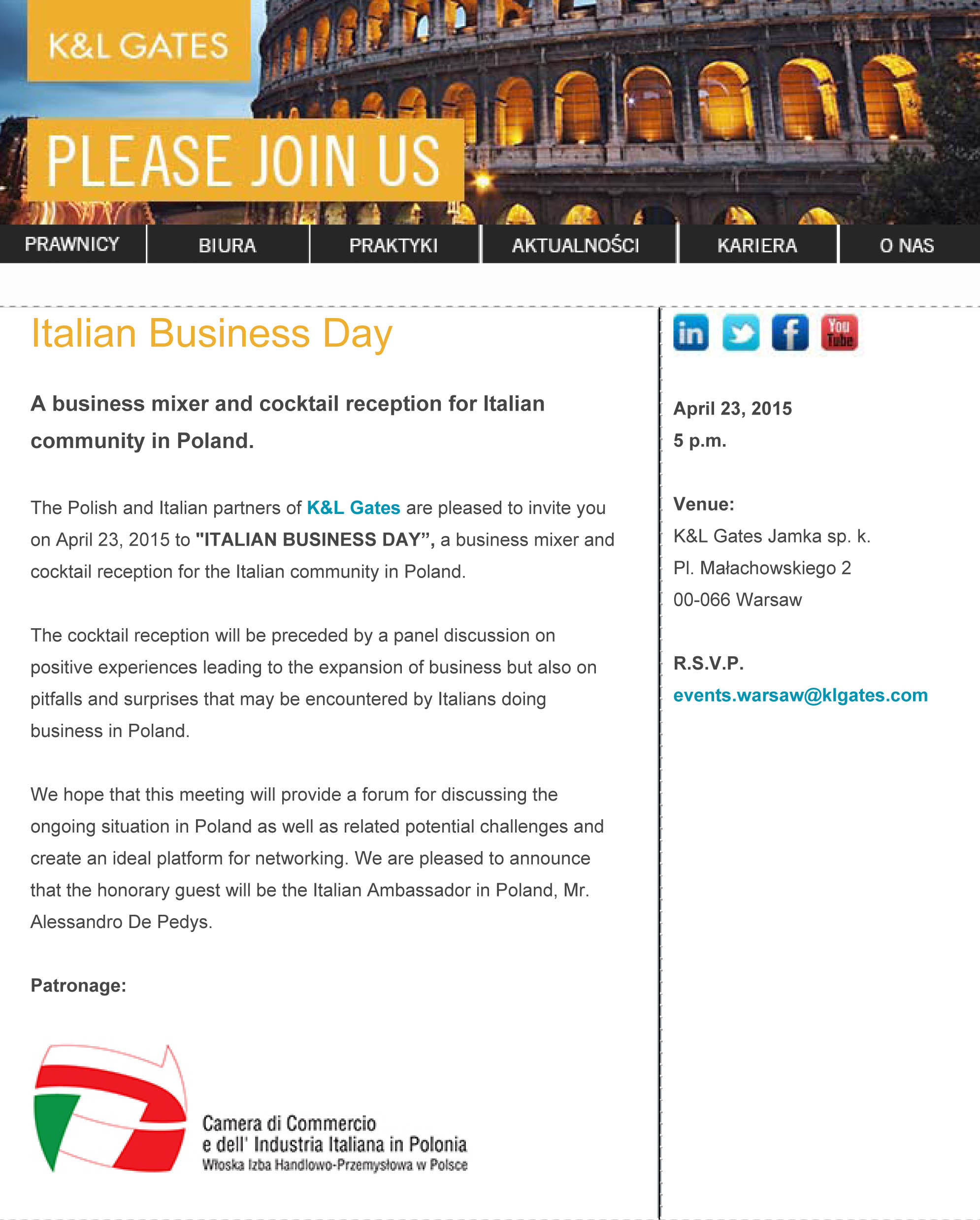
A business mixer and cocktail reception for Italian community in Poland.
The Polish and Italian partners of K&L Gates are pleased to invite you on April 23, 2015 to “ITALIAN BUSINESS DAY”, a business mixer and cocktail reception for the Italian community in Poland.
The cocktail reception will be preceded by a panel discussion on positive experiences leading to the expansion of business but also on pitfalls and surprises that may be encountered by Italians doing business in Poland.
We hope that this meeting will provide a forum for discussing the ongoing situation in Poland as well as related potential challenges and create an ideal platform for networking. We are pleased to announce that the honorary guest will be the Italian Ambassador in Poland, Mr. Alessandro De Pedys.
PROGRAM
Welcome Speech: Maciej Jamka, Administrative Partner of K&L Gates’ Warsaw office and Giampaolo Salsi, Administrative Partner of K&L Gates’ Milan office
Opening Speech: Alessandro De Pedys, Italian Ambassador in Poland
Panel Discussion:
- Alessandro Mazzola, Project Director, Saipem
- Donato Di Gilio, President and CEO, Investments Group (tbc)
- Roberto Privitera, Italian Law School, Warsaw University
- Dariusz Karwowski, Polish Information and Foreign Investment Agency
- Piotr Augustyniak, Partner, Head of the Tax Department, K&L Gates’ Warsaw office
Segafredo coffee and cuisine prepared by Italian Chef will be served at the event.
For car enthusiasts there will be an opportunity to sign up for a drive in a Ferrari at a chosen date.
April 23, 2015
5 p.m.
Venue:
K&L Gates Jamka sp. k.
Pl. Ma?achowskiego 2
00-066 Warsaw
R.S.V.P.
events.warsaw@klgates.com


![[cml_media_alt id='113417']Kurtyka - Perugia (13)[/cml_media_alt]](https://www.gazzettaitalia.pl/wp-content/uploads/2015/08/Kurtyka-Perugia-13.jpg)
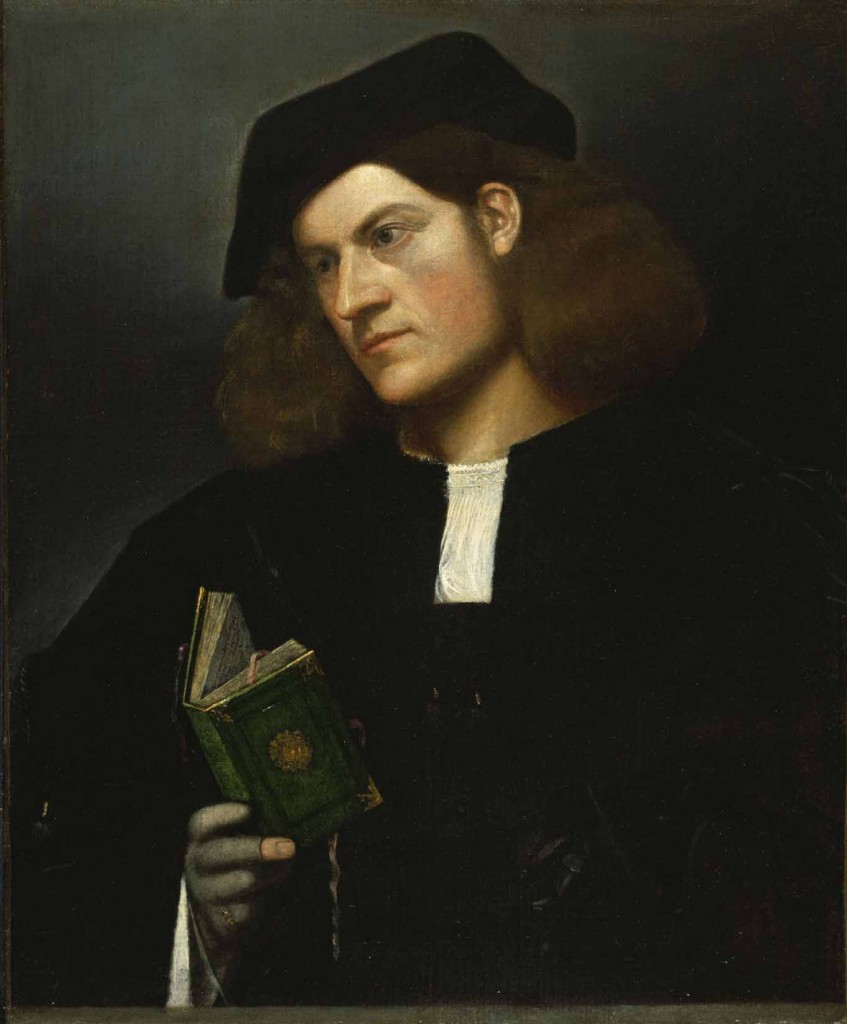
![[cml_media_alt id='113411']Bortoluzzi - Aldo Manuzio (1)[/cml_media_alt]](https://www.gazzettaitalia.pl/wp-content/uploads/2015/08/Bortoluzzi-Aldo-Manuzio-1-228x300.jpg) atteri aldini” che trarrà il nome l’Accademia Aldina, che Manuzio fondò per accogliere i numerosi artisti e studiosi che erano fuggiti da Bisanzio per rifugiarsi a Venezia. Nel 1501 comparve poi la sua edizione di Virgilio in quel carattere corsivo che aveva fatto incidere dal bolognese Francesco Griffo, che diventò tanto celebre da essere d’allora in poi imitato da tutti. Non solo: il volume era anche “in ottavo”, e quindi in un formato molto ridotto rispetto ai grandi e maestosi volumi “in folio” (cioè un foglio piegato in due, ossia quattro pagine) o a quelli “in quarto” (cioè di otto pagine). La “enchiridion forma” rese così il libro, per la prima volta, letteralmente maneggevole, leggero e quindi facilmente trasportabile, cambiando radicalmente le occasioni e le abitudini di lettura. Le opere stampate da Aldo Manuzio ancora oggi, a più di cinque secoli di distanza, suscitano interesse e meraviglia: le circa 130 edizioni in greco, latino e volgare da lui pubblicate in 20 anni di attività sono infatti tuttora studiate in tutto il mondo, e si può ben dire che il suo catalogo costituì una specie di enciclopedia del sapere umanistico.
atteri aldini” che trarrà il nome l’Accademia Aldina, che Manuzio fondò per accogliere i numerosi artisti e studiosi che erano fuggiti da Bisanzio per rifugiarsi a Venezia. Nel 1501 comparve poi la sua edizione di Virgilio in quel carattere corsivo che aveva fatto incidere dal bolognese Francesco Griffo, che diventò tanto celebre da essere d’allora in poi imitato da tutti. Non solo: il volume era anche “in ottavo”, e quindi in un formato molto ridotto rispetto ai grandi e maestosi volumi “in folio” (cioè un foglio piegato in due, ossia quattro pagine) o a quelli “in quarto” (cioè di otto pagine). La “enchiridion forma” rese così il libro, per la prima volta, letteralmente maneggevole, leggero e quindi facilmente trasportabile, cambiando radicalmente le occasioni e le abitudini di lettura. Le opere stampate da Aldo Manuzio ancora oggi, a più di cinque secoli di distanza, suscitano interesse e meraviglia: le circa 130 edizioni in greco, latino e volgare da lui pubblicate in 20 anni di attività sono infatti tuttora studiate in tutto il mondo, e si può ben dire che il suo catalogo costituì una specie di enciclopedia del sapere umanistico.